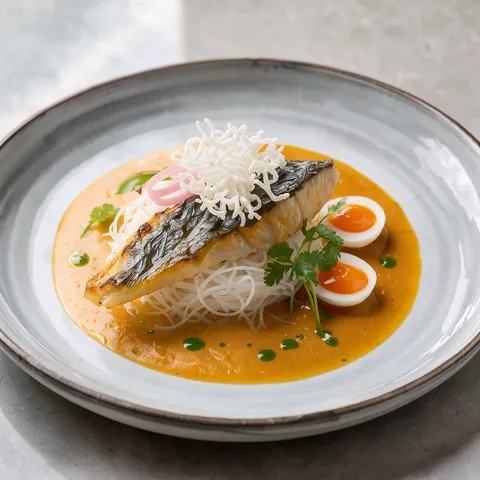
Mohinga 2.0
A Burmese main course. Takes 1 hr 25 min, Serves 4. Difficulty: challenging.
At a glance
- Total time
- 1 hr 25 min
- Serves
- Serves 4
- Difficulty
- Challenging
- Cuisine
- Burmese cuisine
- Dish type
- Main course
- Allergens
- Gluten, Eggs, Fish, Crustaceans, Peanuts
Ingredients
Sea bass and fumet
- 2 whole sea bass (about 500 g each, scaled and gutted)
- 1/2 tsp salt
- 2 tbsp sunflower oil (1 tbsp per batch)
- 900 ml cold water
- 1 lemongrass stalk (bruised)
- 15 g ginger (sliced)
- 1/4 tsp turmeric
Mohinga paste
- 1 medium onion (about 130 g)
- 3 garlic cloves
- 20 g ginger
- 2 lemongrass stalks (lower white part)
- 1/2 tsp turmeric
- 1 tsp sweet paprika
- 1/4 tsp hot chilli powder
- 2 tbsp water
- 40 ml groundnut oil
- 1/2 tsp shrimp paste (ngapi)
Toasted thickener
- 20 g rice
- 20 g gram flour
- 120 ml cold water
To finish the velouté
- 2 tbsp fish sauce
- 1/2 tsp freshly ground black pepper
- 1 tbsp lime juice
Lemongrass and coriander oil
- 30 g coriander (stalks and leaves)
- 1 lemongrass stalk (finely chopped)
- 100 ml sunflower oil
Noodles
- 120 g dried thin rice noodles (100 g for soft nests, 20 g for crisps)
- 650 ml sunflower oil (for frying)
Eggs
- 8 quail's eggs
Shallot pickle
- 3 shallots (2 mm rings)
- 2 tbsp lime juice
- a pinch of salt
- a pinch of sugar
To finish
- coriander cress
- 1/4 tsp chilli flakes
- flaky salt
Equipment
- Filleting knife
- Plating tweezers
- Saucepan
- Fine sieve / chinois
- Muslin
- Frying pan
- Blender
- Balloon whisk
- Heavy-based saucepan
- Mixing bowls
- Probe thermometer
- Colander
- Cast-iron frying pan
- Silicone spatula
- Chef's knife
- Chopping board
Method
- Fillet the sea bass: The workflow is: filleting and fumet, thickener, paste and velouté, oil, eggs and pickle, noodles, fish (two batches), plating, 85 min in total. With a filleting knife, take two fillets from each sea bass and pull out the pin bones with tweezers. Score the skin shallowly 3-4 times, pat dry with kitchen paper, sprinkle salt on the flesh side and leave in the fridge with the skin uncovered: dried skin crisps up in the pan. Remove the gills from the heads and set the heads aside with the bones for the fumet: gills make the stock bitter
- Make the fumet: Put the heads and bones in a saucepan with the cold water and add the lemongrass, ginger and turmeric. Bring almost to the boil, skim off the foam, then lower the heat and simmer gently for 20 min. If fish bones boil for long, the stock turns chalky and cloudy. Pass through a fine sieve lined with muslin: about 750 ml of clear, golden stock remains
- Prepare the thickener: While the fumet cooks, toast the rice in a dry frying pan over medium heat for 6 min, until golden, and grind it to a fine powder in a blender. Toast the gram flour in the same pan over low heat for 3 min, until it smells nutty. Whisk both with the 120 ml cold water to a lump-free slurry
- Fry the paste: Dry the blender and blend the onion, garlic, ginger, lemongrass, turmeric, paprika, chilli powder and 2 tbsp water to a smooth paste. Heat the oil in a heavy-based saucepan over medium heat, add the paste and shrimp paste and fry, stirring constantly, for 10 min, until deep orange and the oil separates
- Make the velouté: Add the strained fumet to the fried paste, bring to the boil and whisk in the slurry in a thin stream. Cook over low heat for 12 min, scraping the base. Blend for 1 min and pass through a fine sieve, pressing with the back of a ladle. You will have about 700-750 ml of silky velouté that thinly coats the back of a spoon. Season with the fish sauce and black pepper, and leave the lime until serving: acid loses its freshness with prolonged heat. Keep hot over low heat without boiling
- Make the green oil: While the velouté cooks, bring water to the boil in a second saucepan. Blanch the coriander for 10 sec, transfer to iced water and squeeze thoroughly. Blend with the lemongrass and oil for 2 min: the friction warms the oil to about 60°C and the colour passes into the oil. Strain through muslin without pressing: about 70 ml of bright green oil remains
- Eggs and pickle: Mix the shallot rings with the lime juice, salt and sugar and leave for 15 min. Boil the quail's eggs in the same boiling water for 2 min 20 sec, transfer to iced water, peel and halve. The yolk should be jammy and the white firm
- Prepare the noodles: Heat the 650 ml oil (about 4 cm deep) in a small, deep 14 cm saucepan to 190°C. Drop in the 20 g of dried noodles in small bundles: within 2-3 sec they puff up like a white cloud. Lift out immediately with a slotted spoon and sprinkle with flaky salt. Cook the remaining 100 g of noodles in boiling water for 3 min, rinse with cold water and twirl into four tight nests with a fork
- Cook the sea bass: Heat the cast-iron frying pan over medium-high heat and add 1 tbsp oil. As the first of two batches, lay half the fillets (2 fillets) skin side down and press lightly with a spatula for the first 30 sec so they do not curl. Cook for 3-4 min, until the skin is golden and crisp and the flesh has turned opaque three-quarters of the way in from the edges, then turn over and leave for 30 sec. A thermometer should read 55°C at the thickest point. Transfer to kitchen paper, skin side up, and keep hot, uncovered, in a warm oven (80°C). Wipe the pan and cook the other 2 fillets the same way with the remaining 1 tbsp oil. The two batches take about 10 min
- Plate: Put the noodle nests in the centre of warm deep plates, pour over a ladle of hot velouté to warm them and leave the excess in the base of the plate. Set the sea bass on top of the nest, skin side up. Arrange four quail's egg halves (2 eggs) beside the fish. Top the fish with the crispy noodle cloud, the drained shallot rings and the coriander cress
- Finish at the table: Finish the remaining velouté with the lime and, at the table, pour it from a small jug around the fish without touching the skin. Drop 6-8 dots of green oil onto the surface of the velouté, then sprinkle over a pinch of chilli flakes and put flaky salt on the skin
Chef's note
The backbone of the classic mohinga is kept: the fish stock with lemongrass and turmeric, the body given by toasted rice and gram flour, the depth of ngapi and fish sauce, soft rice noodles and boiled egg. The novelty lies in separating the elements: crisp-skinned sea bass instead of flaked fish, a strained, silky velouté instead of a thick soup, and a puffed rice noodle crisp instead of fried split pea fritters. Ngapi, fish sauce and dried rice noodles are bought ready-made. If ngapi is unavailable, leave it out or add 1/2 tsp fish sauce. As the velouté is poured at the table, the fish skin stays crisp.
Frequently asked questions
- Why can the fish fumet turn cloudy and chalky?
- If fish bones boil for long, the liquid turns cloudy. Simmer the fumet gently and strain it through muslin, and remove the gills beforehand or they add bitterness.
- Why is the lemon added to the velouté last?
- Acid loses its freshness with long heat. So the lemon is added at the table, at the moment of serving.
- How do crispy rice noodles puff up?
- Drop small bundles of dry noodles into oil at 190°C. They puff up like a white cloud in a few seconds, so lift them out straight away with a slotted spoon.
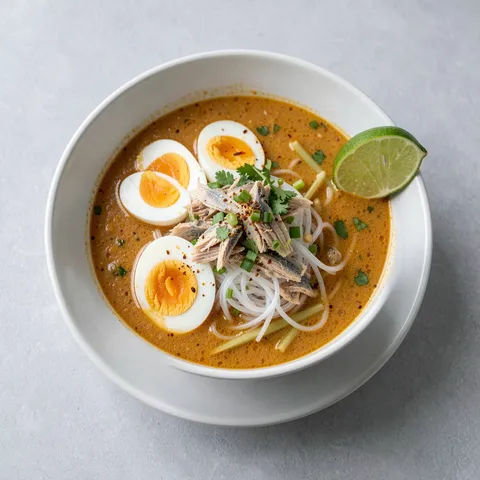 Burmese Lemongrass Fish Soup with Rice Noodles1 hr 10 min · Soup
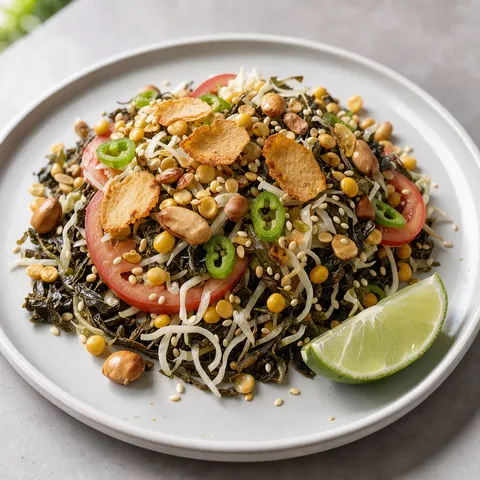 Burmese Fermented Tea Leaf Salad45 min · Meze
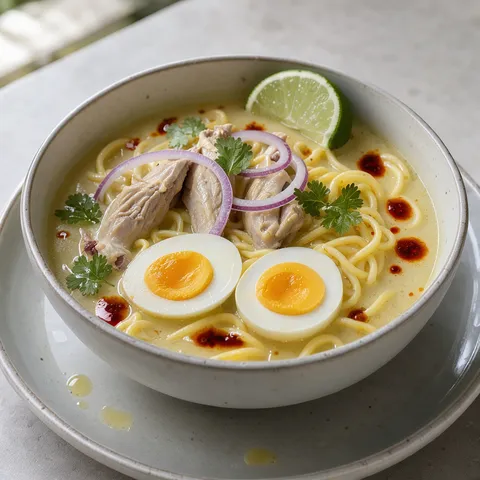 Burmese Coconut Chicken Noodle Soup1 hr 5 min · Main course
 Burmese Semolina Cake with Coconut Milk1 hr 40 min · Dessert
 Shan Rice Noodles with Chicken Sauce55 min · Main course
 Shan Homemade Chickpea Tofu Salad35 min · Meze
 Burmese Slow-Cooked Beef Curry1 hr 45 min · Main course